How Much Should You Feed a Cat? (Wet vs Dry)
How much to feed a cat by weight and age, wet vs dry portions, and how to read the calories on the label — a simple feeding guide that helps prevent obesity.
On this page
If you’ve ever stood in the kitchen holding a scoop and thinking “…is this too much? too little?”, congratulations — you care more than most, and you’re asking the single most important nutrition question there is. Because here’s the uncomfortable truth: the leading nutritional problem in pet cats isn’t starvation. It’s the opposite. Somewhere around half of pet cats are overweight, and it quietly shaves years off their lives.
The good news is that feeding a cat the right amount isn’t complicated once you know the two numbers that matter. Let’s demystify it.
The one number that beats any chart
Every feeding chart (including mine below) is a starting point, not a law. The real answer is written on your cat’s body: you should be able to feel their ribs easily (like the back of your hand) and see a slight waist from above. If you can’t feel ribs, feed a bit less. If ribs stick out sharply, feed a bit more — and see a vet.
Start with calories, not scoops
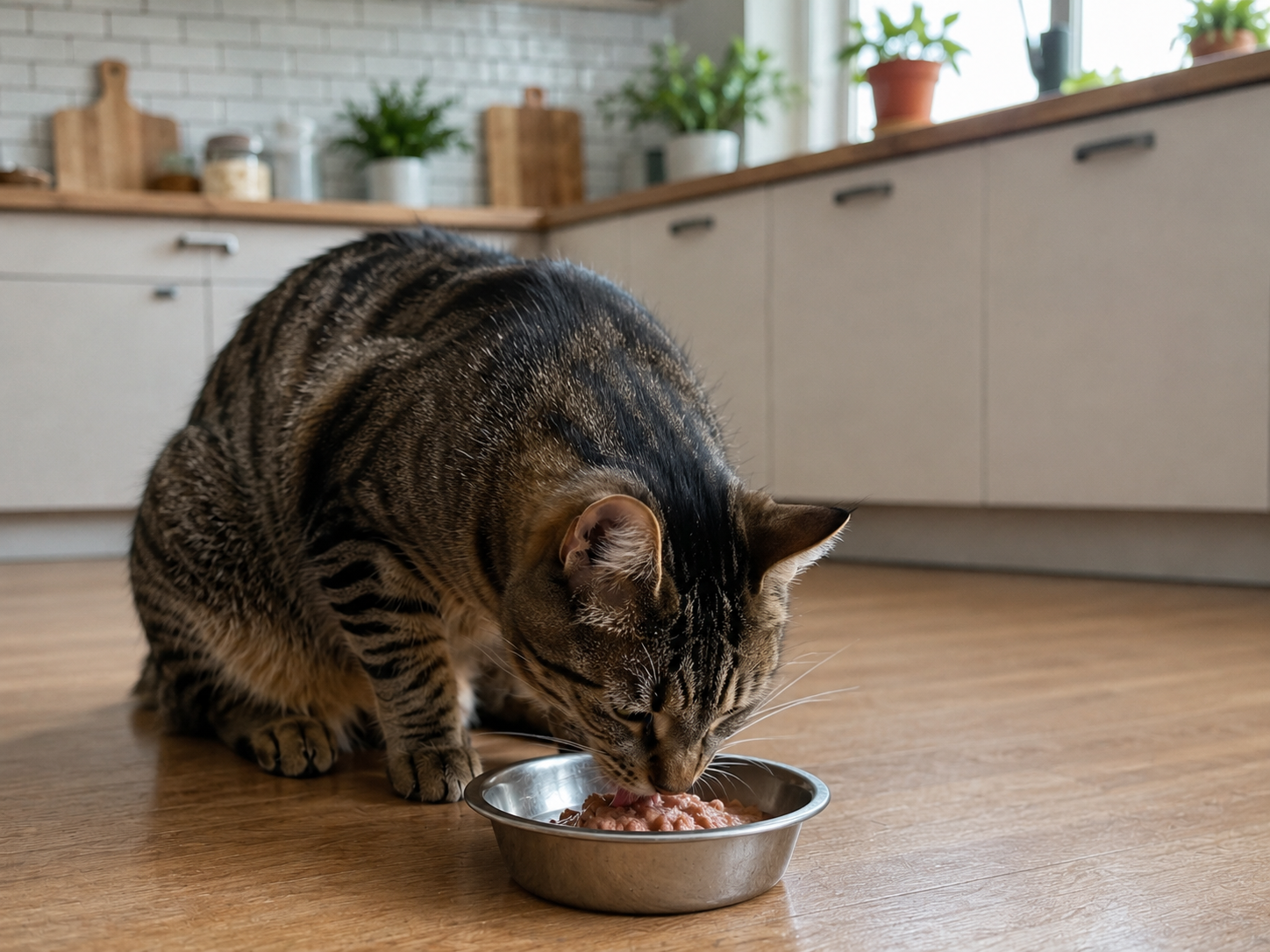
The mistake almost everyone makes is feeding by volume (“a cup a day”) without knowing the calories in that cup. Two foods can look identical in the bowl and differ hugely in energy.
A widely cited starting point for a healthy adult cat (see our sources below) is about 20 calories per pound of ideal body weight per day (around 45 kcal per kg). So a lean, healthy 10-lb (4.5 kg) cat needs roughly 200 calories a day — from all sources, treats included.
Where do you find the calories? On the packaging, listed as “kcal per cup” or “kcal per can” (sometimes as “ME” — metabolizable energy). Once you have that, the math is easy:
Daily calories ÷ calories per cup or can = how much to feed.
That’s the whole formula. Everything else is fine-tuning.
Feeding chart by weight (healthy adult cats)
Here’s a practical starting guide. These are total daily calories for a neutered, indoor adult cat at a healthy weight — split across their meals.
| Cat’s ideal weight | Approx. daily calories | Rough guide (dry food)* | Rough guide (wet food)* |
|---|---|---|---|
| 5 lb (2.3 kg) | ~120 kcal | ~1/4–1/3 cup | ~1.5 cans (3 oz) |
| 8 lb (3.6 kg) | ~170 kcal | ~1/3–1/2 cup | ~2 cans (3 oz) |
| 10 lb (4.5 kg) | ~200 kcal | ~1/2 cup | ~2.5 cans (3 oz) |
| 12 lb (5.4 kg) | ~230 kcal | ~1/2–2/3 cup | ~3 cans (3 oz) |
| 15 lb (6.8 kg) | ~270 kcal | ~2/3–3/4 cup | ~3.5 cans (3 oz) |
* Portions are estimates only — foods vary a lot in calorie density, so always check your specific bag or can and adjust to your cat’s body condition. Feed toward your cat’s ideal weight, not their current one if they’re overweight.
Health conditions change the rules
Kittens, pregnant or nursing cats, seniors, and cats with diabetes, kidney disease, hyperthyroidism or obesity all have different needs — sometimes very different. This is a general guide for healthy adult cats. For a cat with any medical condition, your vet’s plan overrides any chart online, including mine.
Wet vs dry: which should you feed?
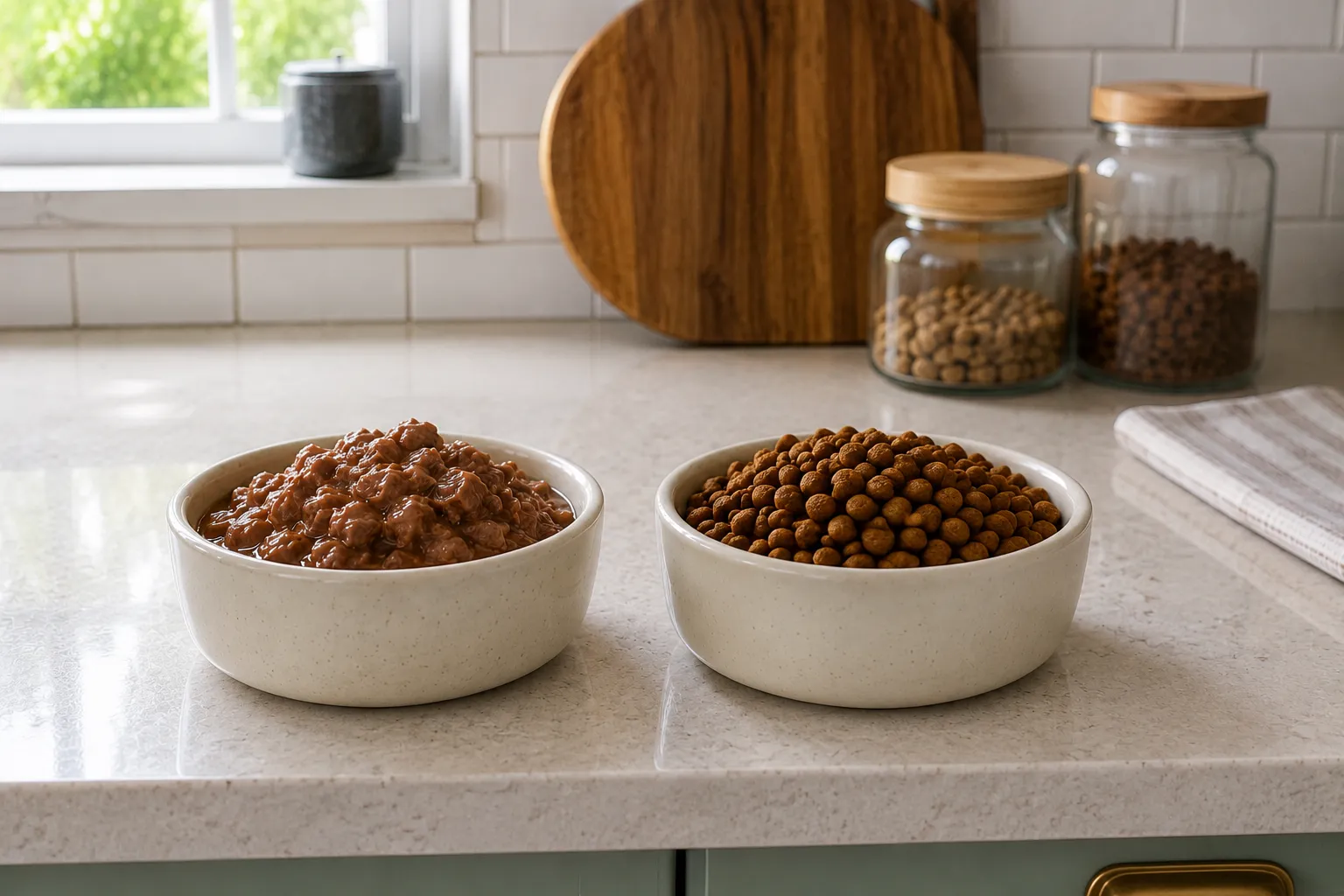
This is the great cat-owner debate, and the honest answer is both have real merits — and many vets recommend a mix. Here’s the plain-English version:
Wet food wins on hydration. Cats evolved from desert animals and have a famously weak thirst drive — they’re built to get most of their water from prey. Wet food is roughly 70–80% moisture, which supports urinary and kidney health. It’s also usually more filling per calorie, which helps weight control, and picky or older cats often find it far more tempting.
Dry food wins on convenience. It’s cheaper per calorie, doesn’t spoil in the bowl, and works in puzzle feeders and timed dispensers. Its downside: it’s calorie-dense and easy to over-serve, and it does little for hydration.
A common, sensible approach: wet food as the main meals (for moisture and satiety) with a measured amount of dry for convenience or enrichment — as long as the total daily calories stay in range. If wet food is your main event, our roundup of the best automatic cat feeders for wet food solves the “but I’m at work all day” problem without leaving food to spoil.
How many meals a day?
Cats are natural grazers who, in the wild, eat many tiny mouse-sized meals. But “grazing” is not the same as a bowl of kibble left out 24/7 — that’s how the weight creeps on.
- Two meals a day (morning and evening) suits most adult cats and keeps portions controlled.
- Small, frequent meals (3–4 tiny portions) can suit some cats better — a timed feeder makes this realistic even when you’re out.
- Kittens need feeding more often — 3–4 meals a day while they’re growing.
- Free-feeding (a full bowl always available) is the easiest route to an overweight cat and is best avoided for most cats, especially with dry food.
One thing worth watching: where the food bowl sits matters as much as when it’s filled. Cats refuse to eat right next to their toilet, and a bowl placed too close to the litter tray is a common hidden cause of both fussy eating and a cat refusing to use the litter box.
Whatever the schedule, measure every portion with an actual scoop or scales. “Eyeballing it” is how a slightly-too-full bowl turns into a 3-lb weight gain over a year.
Don’t forget the treats
Here’s the trap that undoes careful feeding: treats. They should make up no more than about 10% of your cat’s daily calories, and — crucially — you have to subtract them from the meals, not add them on top. A few treats a day plus full meals is a very common, very sneaky source of weight gain.
Fresh water, always
However you feed, keep clean water available at all times — a wide bowl away from the food, or a pet water fountain, since many cats drink more from moving water. Cats on mostly-dry diets especially need easy access to water for urinary health.
Getting the amount right over time
Set a starting amount from the chart, then weigh your cat every couple of weeks (step on the scales holding your cat, then subtract your own weight — a kitchen-scales-for-cats moment) and do a hands-on body check. Adjust up or down by about 10% and give it a few weeks before judging. Slow and steady wins — cats should never be crash-dieted, as rapid weight loss can cause a serious liver condition.
If you’re still finding your feet as a cat owner, feeding is just one piece of the puzzle — our first-time cat owner’s guide pulls the whole first-month setup together, from vet visits to litter.
Frequently asked questions
How much should I feed my cat per day?+
A healthy adult cat needs roughly 20 calories per pound of ideal body weight daily — about 200 calories for a lean 10-lb cat, from all food and treats combined. Translate that into portions using the 'kcal per cup or can' figure on your specific food, then adjust based on whether you can easily feel your cat's ribs and see a slight waist.
Is wet or dry food better for cats?+
Both have benefits. Wet food is about 70–80% water, which supports hydration, urinary and kidney health, and it's often more filling and tempting for picky or senior cats. Dry food is cheaper, convenient and works in puzzle feeders, but it's calorie-dense and does little for hydration. Many vets suggest a mix — wet as the main meals plus a measured amount of dry.
How many times a day should I feed my cat?+
Two measured meals a day (morning and evening) suits most adult cats. Some do well on several small portions, which a timed feeder makes easy. Kittens need 3–4 meals a day. Avoid leaving a full bowl out all day, as free-feeding is a leading cause of feline obesity.
How do I know if I'm overfeeding my cat?+
Do a body-condition check: you should be able to feel the ribs easily with a light touch and see a slight waist when looking down from above. If you can't feel the ribs, or there's no waist and a rounded belly, your cat is likely overweight. Around half of pet cats are, so it's very common — cut back gradually and check with your vet.
Should I leave food out all day for my cat?+
Generally no. Free-feeding, especially with dry food, makes it very easy for cats to overeat and gain weight. Measured meals or a timed feeder give you control over portions. The exception is on veterinary advice for certain medical situations — always follow your vet's guidance for a cat with a health condition.
The bottom line
Feeding a cat well comes down to two numbers and one habit: know the calories your cat needs (about 20 per pound of ideal weight), know the calories in the food (check the bag or can), and measure every meal instead of eyeballing it. Lean toward wet food for hydration, keep treats under 10%, skip the all-day buffet, and let your cat’s ribs and waist be the final judge. Get that right and you’re not just feeding your cat — you’re buying them healthy extra years.
Sources & further reading
This article draws on guidance from these trusted organizations. Always consult your own veterinarian for advice specific to your pet.
Written by
Raghav DeedwaniyaFounder & Editor
Raghav Deedwaniya is the founder and editor of Petifys, and the author behind its pet care content. I’m a lifelong pet owner, not a veterinarian — I’ve been around dogs since childhood, and that hands-on experience is what got me into writing about responsible pet ownership. At Petifys I create practical, easy-to-understand guides, each one carefully researched using trusted sources such as the AVMA, ASPCA and International Cat Care. My aim is to help you make informed everyday decisions — but for anything involving your pet’s health, always consult a qualified veterinarian who can examine your animal in person.
Disclosure: Some links in this article are affiliate links. If you buy through them we may earn a small commission at no extra cost to you. We only recommend products we believe in. Learn more.