Guinea Pig Care for Beginners: Complete Guide
New to guinea pigs? This beginner's guide covers cage size, diet, vitamin C, why they need a friend, and the health signs that mean call a vet today.
On this page
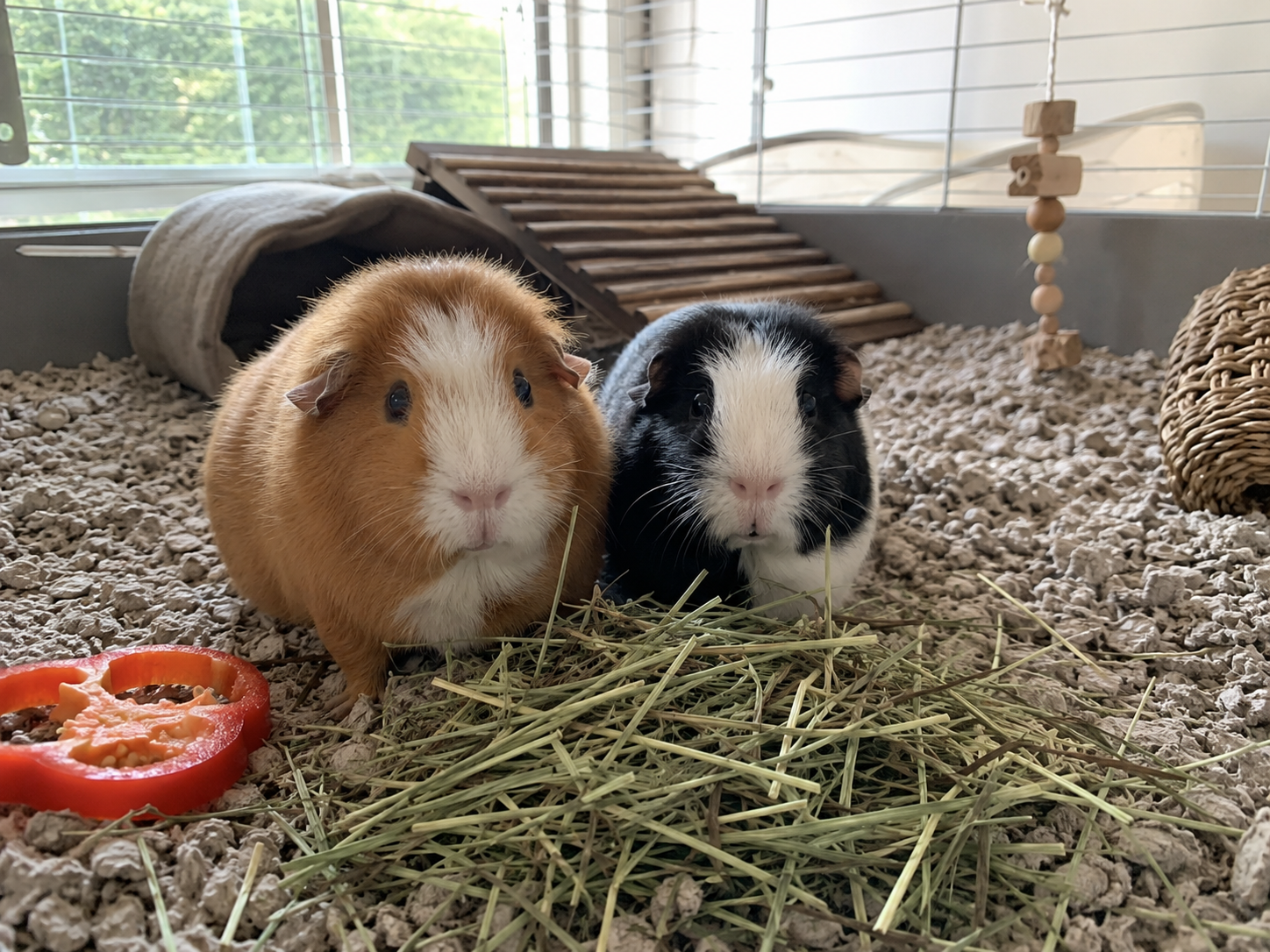
Guinea pig care for beginners comes down to four things most pet shops never mention: they need a companion, a cage far bigger than the ones sold in stores, unlimited hay, and a daily source of vitamin C. Get those right and guinea pigs are wonderfully easy, chatty, gentle little animals that rarely bite and genuinely seem pleased to see you.
Get them wrong and you end up with a lonely, poorly pig and a lot of vet bills. So let’s do it properly from day one.
The four rules, in one line
Never keep just one, give them at least 7.5 square feet of floor space, feed unlimited grass hay, and serve fresh vitamin C every single day.
Do guinea pigs need to live in pairs?
Yes. This is the single most important thing on this page.
Guinea pigs are herd animals. In the wild they live in groups, and being alone is genuinely stressful for them. A solitary guinea pig is more prone to depression-like behavior, boredom and stress-related illness. It matters so much that in Switzerland and Sweden, keeping a guinea pig alone is actually against animal welfare law.
So adopt two. Some practical guidance:
- Two females is the easiest starter pairing.
- Two males can work, especially littermates, but give them more space and two of everything (hides, bowls, water bottles) to prevent squabbles.
- A male and a female will breed, quickly and repeatedly, so the male needs neutering by a vet first.
- Never house them with rabbits. It is a common pet-shop suggestion and a bad one: rabbits kick hard enough to injure a guinea pig, they eat different diets, and rabbits carry bacteria that can make guinea pigs seriously ill.
Two guinea pigs are barely more work than one, and you get to watch them talk to each other, which is most of the fun.
How big should a guinea pig cage be?
Bigger than you think, and almost certainly bigger than the cage being sold as a “guinea pig cage”.
The Humane Society recommends a minimum of 7.5 square feet of floor space for one guinea pig, and at least 10.5 square feet for a pair. More is genuinely better. Guinea pigs run in short bursts, and floor space is what they actually use.
What to look for:
- Solid flooring, never wire. Wire floors cause a painful foot condition called bumblefoot.
- One level is fine. Unlike hamsters, guinea pigs are not climbers, so height matters far less than floor area.
- At least two hides, one per pig, so nobody gets cornered. They are prey animals and a pig with nowhere to hide is a stressed pig.
- Indoors, out of direct sun and draughts. Guinea pigs handle cold poorly and overheat easily above roughly 26°C (79°F).
For bedding, use paper-based bedding or kiln-dried aspen. Avoid cedar and pine shavings, which release oils that can irritate a guinea pig’s airways. Spot-clean daily, full change weekly.
Skip the wheels and exercise balls. Those are hamster products. A guinea pig’s spine does not bend that way, and using them risks real injury. Give them floor time in a safe playpen instead.
What do guinea pigs eat?
Think of a guinea pig’s diet as a pyramid, and hay is the enormous base.
1. Unlimited grass hay (about 80% of the diet). Timothy, orchard or meadow hay should be available at all times, all day. This is not optional filler. Hay does two critical jobs: the constant chewing grinds down teeth that never stop growing, and the fiber keeps their gut moving. A guinea pig that stops eating hay is a guinea pig in trouble. If you also keep rabbits, the same hay works for both, and our guide to what rabbits eat explains the fiber-first logic in more detail.
2. Fresh vegetables daily (about one cup per pig). This is where vitamin C comes in, see the next section.
3. A small measured portion of pellets (about 1/8 cup per pig, daily). Choose plain, timothy-based guinea pig pellets. Avoid the colorful mixes with seeds, corn and dried fruit, because pigs pick out the junk and leave the healthy parts.
4. Fruit as a rare treat. A thin slice of apple or a couple of blueberries, a couple of times a week at most. It is sugary.
5. Fresh water, always. Change it daily. Many owners offer both a bottle and a heavy ceramic bowl.
Never feed guinea pigs these
Iceberg lettuce (little nutrition, causes loose stools), potato, onion, garlic, avocado, rhubarb, chocolate, bread, dairy, meat, seeds and nuts, and anything from the cabbage family in large amounts (gas). When adding any new vegetable, introduce it slowly over a few days.
Why vitamin C matters so much
Here is the quirk that catches nearly every new owner out: guinea pigs cannot make their own vitamin C. Humans have the same problem, which is why sailors once got scurvy. Guinea pigs get scurvy too, and it shows up as stiffness, reluctance to move, swollen joints, poor coat and bleeding gums.
The fix is easy and cheap: fresh vitamin C food every day.
The best sources, roughly in order:
- Bell pepper (red, yellow or green). A slice a day is the single easiest win. Most pigs love it.
- Leafy greens such as romaine lettuce, coriander, parsley and kale (kale in moderation).
- Broccoli and cherry tomato, in small amounts.
Do not rely on vitamin C drops in the water bottle. Vitamin C breaks down quickly in light and water, so by the time your pig drinks it, much of it is gone. It also makes the water taste odd, which can put them off drinking. Fresh food is far more reliable.
Handling, and how to build trust
Guinea pigs are prey animals, so being scooped from above is alarming at first. Go slowly:
- Let them settle for a few days before much handling. Sit near the cage and talk to them so your voice becomes normal.
- Bribe shamelessly. Offer a piece of bell pepper through the bars, then from your flat palm inside the cage.
- Lift with two hands, one supporting the chest, one under the back end. Never lift by the middle alone, and never by the scruff.
- Hold them on your lap with a towel, low to the ground, so a wriggle is not a fall. Ten calm minutes beats one long stressful session.
Signs they are happy: “popcorning” (sudden joyful little jumps), and “wheeking”, the loud excited squeal that means they heard the fridge open and have decided it is dinner time.
Health basics and warning signs
Guinea pigs live roughly 5 to 7 years, which is longer than hamsters and a real commitment. Routine care:
- Weigh them weekly on kitchen scales. Weight loss is often the first sign of illness, well before anything looks wrong.
- Trim nails every few weeks.
- Check teeth and bottoms during cuddles.
- Brush long-haired breeds such as Peruvians regularly.
- Find a vet who treats small animals or exotics before you need one. Not every practice does.
Call a vet the same day if your guinea pig...
Stops eating or drinking, produces no droppings, sits hunched and still, has labored or wheezy breathing, has a wet or crusty nose or eyes, drools or paws at the mouth (dental pain), develops a lump, or drags its back legs. A guinea pig that has not eaten for 12 hours is an emergency, because their gut can shut down quickly. This article is general guidance, not veterinary advice.
Are guinea pigs a good first pet?
Honestly, they are one of the better small-pet choices for a beginner, with a few caveats.
In their favour: they rarely bite, they are awake during the day when you are, they are big enough to handle comfortably, and they are chatty and interactive rather than hiding constantly.
Be realistic about: the space (that cage is big and lives in your house), the daily fresh veg (this is a genuine daily job, not a weekly one), the 5 to 7 year commitment, and the fact you need two.
If the daily veg prep and floor space sound like a lot, a hamster is a smaller commitment, though a mostly nocturnal one. Our hamster care guide lays out that trade-off. If you want something bigger and more dog-like in personality, compare notes with our rabbit care beginner’s guide.
Frequently asked questions
Can guinea pigs live alone?+
They shouldn't. Guinea pigs are herd animals and being kept alone causes real stress, boredom and stress-related illness. Keeping a single guinea pig is even illegal in Switzerland and Sweden. Adopt at least two: two females is the easiest pairing, and any male housed with a female must be neutered first.
How big should a guinea pig cage be?+
The Humane Society recommends at least 7.5 square feet of floor space for one guinea pig and 10.5 square feet or more for a pair. Most cages sold as 'guinea pig cages' are too small. Prioritise floor area over height, insist on solid flooring rather than wire, and provide one hide per pig.
What do guinea pigs eat every day?+
Unlimited grass hay such as timothy or meadow hay makes up about 80% of the diet, plus roughly one cup of fresh vegetables per pig for vitamin C, about an eighth of a cup of plain timothy-based pellets, and constant fresh water. Fruit is a small treat only, a couple of times a week.
Why do guinea pigs need vitamin C?+
Guinea pigs cannot produce their own vitamin C, so without a daily dietary source they develop scurvy, which causes stiffness, swollen joints, a poor coat and bleeding gums. Bell pepper is the easiest daily source. Avoid relying on vitamin C drops in water, because the vitamin degrades quickly and can put pigs off drinking.
How long do guinea pigs live?+
Typically 5 to 7 years with good care, and sometimes longer. That is considerably longer than hamsters, so treat a guinea pig as a multi-year commitment rather than a starter pet you'll outgrow quickly.
Can guinea pigs live with rabbits?+
No. Despite being sold as companions, rabbits can injure guinea pigs with a single kick, the two species need different diets, and rabbits can carry bacteria that make guinea pigs seriously ill. Guinea pigs should be housed with other guinea pigs.
The bottom line
Guinea pig care is simple once the setup is right: two pigs, a big solid-floor cage indoors, hay available every hour of the day, a slice of bell pepper for vitamin C, a small scoop of plain pellets, and weekly weigh-ins so you catch problems early. Skip the wheels, skip the muesli-style food, and never house them with a rabbit.
Do that and you get five-plus years of popcorning, wheeking and a small animal that is genuinely delighted when you walk in the room.
Sources & further reading
This article draws on guidance from these trusted organizations. Always consult your own veterinarian for advice specific to your pet.
Written by
Raghav DeedwaniyaFounder & Editor
Raghav Deedwaniya is the founder and editor of Petifys, and the author behind its pet care content. I’m a lifelong pet owner, not a veterinarian — I’ve been around dogs since childhood, and that hands-on experience is what got me into writing about responsible pet ownership. At Petifys I create practical, easy-to-understand guides, each one carefully researched using trusted sources such as the AVMA, ASPCA and International Cat Care. My aim is to help you make informed everyday decisions — but for anything involving your pet’s health, always consult a qualified veterinarian who can examine your animal in person.
Disclosure: Some links in this article are affiliate links. If you buy through them we may earn a small commission at no extra cost to you. We only recommend products we believe in. Learn more.